



About Us
Nebulabio is a pioneering biotechnology Contract Research Organization (CRO) at the forefront of alternative antibody scaffold discovery. While traditional platforms focus on the heavy chain or paired chains, our Light Chain Antibody Library platform unlocks a novel dimension of the humoral immune repertoire. We specialize in isolating and exploiting the intrinsic binding capacity of antibody light chains (VL domains), building high-diversity libraries for the discovery of unique binding molecules. With deep expertise in protein engineering and single-domain biology, we partner with therapeutic and diagnostic developers to target epitopes that are inaccessible to conventional antibodies. Our platform is dedicated to exploring this underexplored frontier, providing clients with a proprietary pipeline to discover compact, stable, and highly soluble single-domain binders derived from the human light chain repertoire.
☞Introduction to Light Chain Antibody Library
The Light Chain Antibody Library is an innovative platform built on a foundational yet often overlooked observation: isolated antibody light chains (VL domains) can possess autonomous, specific antigen-binding properties. While in a canonical antibody, the heavy chain (VH) contributes more to antigen binding, the variable light chain domain is a stable, immunoglobulin-like fold capable of independent function.
Our platform involves constructing large combinatorial phage display libraries exclusively from the repertoire of human antibody light chain variable (VL) genes. These libraries display the VL domain as a single, isolated protein on the phage surface, without its paired heavy chain partner. This allows for the selection of VL domains that have evolved or can be engineered to bind targets with high affinity and specificity on their own.
These light chain-derived binders, sometimes referred to as "LC single-domain antibodies" or "VL-sdAbs," share many desirable properties with heavy-chain-derived VHHs (Nanobodies):
Small size (~12-15 kDa)
High stability and solubility
Excellent tissue penetration
Potential for binding cryptic epitopes
Our library taps into the vast natural diversity of human light chain sequences (kappa and lambda), offering a rich source of fully human, single-domain scaffolds for therapeutic, diagnostic, and research applications.
☞Advantages of Light Chain Antibody Libraries
Utilizing a Light Chain Antibody Library offers several distinct strategic and technical advantages:
Access to a Novel, Fully Human Scaffold: The VL domain is a natural human protein with low inherent immunogenicity. This provides a direct route to fully human binders without the need for humanization required from animal-derived VHHs.
Exploitation of Unique Paratope Topology: The antigen-binding site of a VL domain has a distinct shape and chemical character compared to a VH or VHH. This enables the discovery of binders to epitopes that may be invisible to other formats, expanding the druggable target space.
Excellent Biophysical Properties: Human VL domains are known for their high expression yields in microbial systems, remarkable solubility, and resistance to aggregation. This translates into leads with superior developability profiles.
Complement to Existing Platforms: A Light Chain Library can discover binders where heavy-chain-focused libraries (scFv, Fab, VHH) may fail, providing a complementary approach in a multi-format discovery campaign to ensure success against challenging targets.
Ideal for Intracellular Applications (Intrabodies): The reducing environment of the cell cytoplasm can destabilize antibodies requiring disulfide bonds. Many VL domains are stable without their conserved intra-domain disulfide, making them outstanding candidates for intracellular expression and function.
Modular Building Block: Like other single-domain binders, selected VLs can be easily multimerized or fused to create biparatopic or biparatopic molecules with enhanced avidity or novel functions.
| ☎ +86-15801534258 | ✉ info@nebulabio.cn | Request a Quote ☜ |
☞Light Chain Antibody Library Construction Process
The construction of a high-quality Light Chain Library follows a meticulous process to ensure maximal functional diversity.
Phase 1: Source Material Acquisition & Gene Amplification
Phase 2: Library Cloning & Assembly
Phase 3: Phage Rescue & Quality Control
|

Figure1.Identification of novel light-chain single-domain antibodies against mCD16 by phage panning.
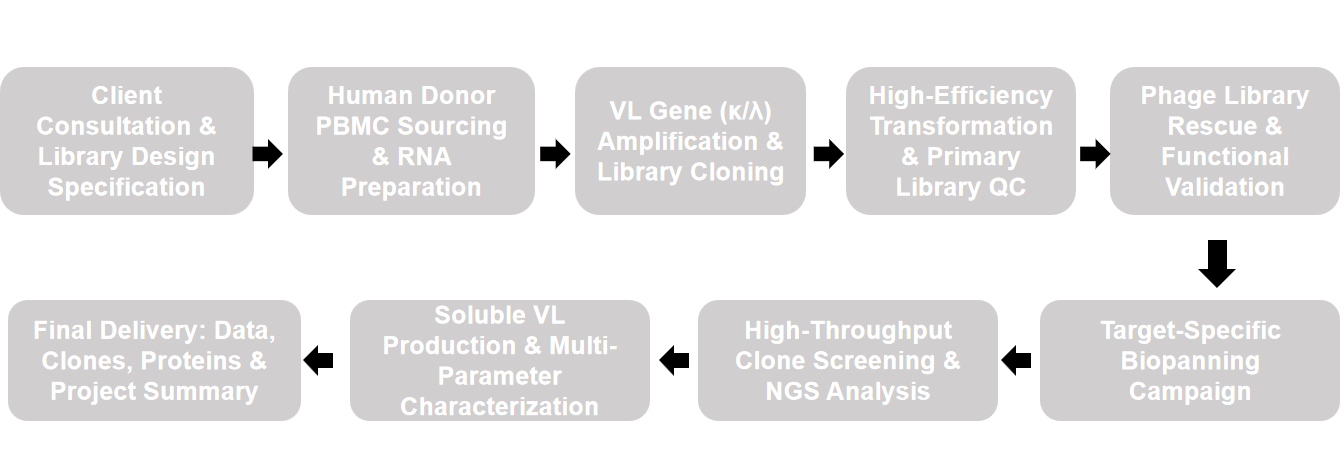
☞Our Integrated Service Workflow
Our comprehensive service covers everything from library construction to the delivery of validated lead candidates.
Step 1: Project Consultation & Strategy
We collaborate to define project goals and decide on library specifications (e.g., focus on kappa, lambda, or both; inclusion of stability motifs).
Step 2: Library Construction & QC
We execute the library build process as described in Section 4. The client receives a QC dossier confirming library size, diversity metrics from NGS, and a sample of the phage stock.
Step 3: Target-Specific Screening (Biopanning)
Using the client's target antigen, we perform 3-4 rounds of phage display biopanning. We employ tailored strategies such as:
Negative depletion against common contaminants.
Solution-phase panning with biotinylated antigen.
Stringency modulation to select for desired affinity.
Step 4: Hit Identification & Sequence Analysis
Monoclonal Screening: Hundreds of individual clones are screened via phage ELISA.
Sequencing & Bioinformatics: Positive clones are sequenced. Our pipeline analyzes sequences, identifies CDR-L3 motifs, clusters families, and selects unique VL leads for further development
Step 5: Soluble Expression & Lead Validation
Selected VL genes are subcloned for soluble expression in E. coli. Purified VL domains undergo characterization:
Binding Validation: ELISA or biolayer interferometry (BLI).
Affinity Measurement: Determination of binding kinetics (KD).
Specificity Profiling: Assessment of cross-reactivity.
Biophysical Assessment: Thermal stability (Tm) via DSF, aggregation propensity.
Step 6: Delivery & Reporting
The final deliverable includes:
A comprehensive report detailing the discovery campaign.
All VL gene sequences and alignment data.
Expression plasmids for lead VL clones.
Purified protein samples of top candidates.
Strategic recommendations for affinity maturation or formatting
Our End-to-End Service Flowchart:
Contact our team to explore how our Native Antibody Discovery Services can deliver the high-quality, functional leads you need to accelerate toward the clinic.
| For more information, please contact us at info@nebulabio.cn or +86-15801534258. |