


From the perspectives of molecular immunology and single-cell biology, this article outlines the core technical chain of single B cell sorting platforms for antibody discovery. It focuses on fluorescence-based antigen probe design and specificity control, multi-parameter gating strategies and single-cell deposition in flow cytometric sorting, key control points for nucleic acid stabilization and reverse transcription/amplification at the single-cell level, and approaches for recovering native heavy-chain (VH) and light-chain (VL) pairing information. In addition, it briefly introduces how droplet microfluidic systems enable high-throughput paired sequencing while preserving pairing relationships, explaining how these platforms obtain expressible antibody sequences under native pairing constraints.
Single B cell sorting platforms aim to directly retrieve antibody sequence combinations that have already undergone in vivo selection within a natural immune repertoire, while preserving the native pairing between heavy and light chains whenever possible. Unlike display libraries that rely on random chain recombination, these platforms start from antigen-specific B cells, convert cell-surface binding events into sortable fluorescence signals, and then transcribe and amplify variable-region sequences from individual cells into information suitable for recombinant expression. Platform performance is typically co-determined by three factors: the accuracy of antigen-specific recognition, the purity and recovery efficiency of single-cell sorting, and the extent to which single-cell amplification preserves VH/VL pairing.
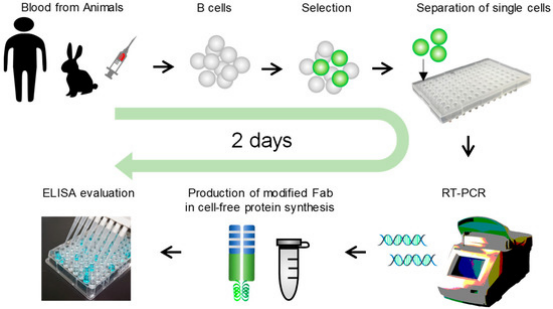
1. Antigen Probe Labeling and Antigen-Specific Recognition
The first step in single B cell discovery workflows is to convert “antigen binding” into a measurable fluorescence signal. A common strategy is to use fluorescently labeled recombinant antigen probes; when the probe binds the B-cell receptor (BCR) on the cell surface, the target cell becomes detectable in the corresponding fluorescence channel. To reduce nonspecific adsorption and label-associated false positives, dual-labeled antigen strategies are frequently employed: the same antigen is conjugated to two distinct fluorophores, and cells are considered antigen-positive only when signals are detected in both antigen channels. This approach strengthens specificity by requiring concordant binding across two independent optical labels.
To avoid propagating low-quality events into downstream amplification, viability dyes and exclusion markers are commonly included, and forward/side scatter features are used to remove debris and compromised cells. The technical objective at this stage is to distinguish true BCR–antigen binding signals from background interactions, thereby increasing the effective proportion of cells from which informative VH/VL sequences can be recovered.
2. Multi-Parameter FACS Gating Design and Single-Cell Deposition
Flow cytometric sorting provides the key transition from a heterogeneous population to isolated single cells. Multi-parameter gating typically integrates three categories of information: (i) sample quality control (e.g., exclusion of doublets/aggregates and selection of viable cells), (ii) B-cell lineage markers (e.g., CD19/CD20), and (iii) antigen-binding signals (single- or dual-labeled antigen channels). For post-immunization samples, immunoglobulin isotype markers can be incorporated to enrich for IgG memory B-cell populations, increasing the likelihood of recovering sequences shaped by affinity maturation.
Events meeting the gating criteria are deposited as single cells into 96-well or 384-well plates, or directly into single-cell reaction formats. The main technical requirement is consistency of gating logic and control of sorting purity. Overly permissive gating increases the fraction of nonspecific cells and reduces the yield of actionable sequences, whereas overly stringent gating can reduce recovery and bias the output toward high-signal subpopulations, thereby narrowing the coverage of repertoire diversity.
3. Key Control Points for Single-Cell Nucleic Acid Stabilization and RT Amplification
At single-cell scale, mRNA abundance is low, and sequence recovery is highly sensitive to degradation; accordingly, post-sort lysis and stabilization are major determinants of success. A common approach is to pre-load collection wells with mild lysis conditions and RNase inhibition so that nucleic acids remain suitable for reverse transcription shortly after cell deposition. Reverse transcription generates cDNA, which is subsequently amplified using primer sets targeting conserved regions within immunoglobulin variable domains and/or constant regions.
Nested PCR is widely used in single-cell workflows to increase recovery and reduce nonspecific amplification. Two rounds of amplification enrich for the intended variable-region products under low-template conditions. The critical control principle is process consistency—standardized handling and minimization of reaction inhibitors—so that biological differences between single cells are not confounded or magnified by variability introduced during sample processing.
4. Practical Routes to Native VH/VL Pair Recovery
A central advantage of single B cell platforms is their ability to preserve native VH/VL pairing. Because heavy and light chains are co-transcribed and co-expressed in the same B cell, single-cell isolation ensures that both chain transcripts are present within the same reaction context, providing the physical basis for pairing retention. A common implementation is to amplify heavy- and light-chain variable regions separately from the same well and carry these products forward into cloning and expression constructs, thereby preserving pairing at the sample level.
For platforms that place greater emphasis on pairing “locking,” strategies can be used to link heavy- and light-chain products within the same reaction framework or to introduce pairing-preserving linkage designs during library construction. In such designs, VH and VL may enter sequencing or expression construction as a single linked product or as products tagged with a shared molecular identifier, enabling downstream association of the correct chain pair. Regardless of the implementation, evaluation should focus on two outcome criteria: (i) the fraction of single cells from which full-length, interpretable VH and VL variable-region sequences are recovered together, and (ii) whether the recovered VH/VL combinations maintain binding specificity and baseline functional behavior consistent with the originating cell after recombinant expression.
5. Conclusion
The molecular basis of single B cell sorting platforms can be summarized as three connected steps: antigen probes convert specific binding events into sortable signals; multi-parameter FACS enriches and deposits individual antigen-specific B cells; and single-cell lysis, reverse transcription, and amplification recover variable-region sequences under low-template conditions while preserving native VH/VL pairing at the single-cell level. When higher throughput is required, droplet microfluidic and barcode-based approaches provide a parallel route to paired-sequence recovery by coupling individual cells to unique molecular identifiers and re-associating VH and VL sequences by barcode during analysis. Together, these mechanisms explain how single B cell platforms retrieve expressible antibody sequences while maintaining native pairing constraints.
| For more information, please contact us at info@nebulabio.cn or +86-15801534258. |