


How do stable overexpression cell lines achieve long-term, reproducible gene expression? This article provides a research-focused overview of the core concepts behind stable expression, commonly used host systems (HEK293/CHO), and standard terminology for delivery routes and selection pressure (puromycin, hygromycin B, Geneticin (G418), blasticidin). It also explains how qPCR, Western blot, flow cytometry, and ELISA are used to confirm expression status, population distribution, and passage-to-passage consistency—offering a structured understanding of stable overexpression cell lines.
1. Biological Fit of HEK293 and CHO Host Systems
The choice of host cell line directly influences recombinant protein folding, post-translational modifications (PTMs), and subcellular localization, which in turn shapes the form and consistency of downstream experimental readouts. Across both research and industrial settings, HEK293 and CHO remain two of the most widely adopted mammalian host platforms. HEK293 cells are highly amenable to gene delivery and often support PTM profiles—particularly glycosylation-related features—that more closely resemble human proteins, making them a common background for receptor pharmacology, signal transduction studies, and viral vector–associated workflows. In contrast, CHO cells are well recognized for strong secretory pathway capacity and culture adaptability, and are therefore frequently used for secreted proteins and antibody-related expression contexts. In stable cell line development, HEK293 is often preferred for intracellular mechanism and signaling investigations, whereas CHO is typically favored when secretion performance, culture behavior, or an engineering-oriented expression context is central. Fundamentally, host selection is an exercise in matching target protein properties with cellular organelle function, modification landscape, and the intended expression readout.
2. Lentivirus-Mediated Genomic Integration and Antibiotic Selection
A defining requirement for stable expression is the long-term retention of an expression cassette in the host genome with sustained transcriptional activity. In addition to non-viral delivery routes, lentivirus-based systems are widely used because they can achieve efficient transduction across many cell types and support genomic integration, which is especially valuable for hard-to-transfect cell lines or specific cellular backgrounds. Lentiviral integration tends to occur in transcriptionally active regions, which mechanistically favors robust and persistent detectable expression.
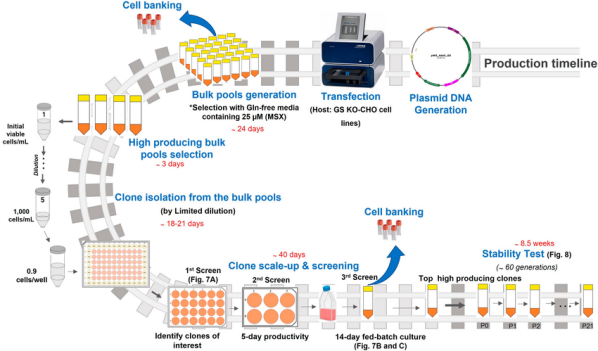
Enrichment of expression-positive cells typically relies on selection pressure, implemented by encoding a resistance marker on the vector and applying antibiotics to eliminate negative-background cells while preserving engineered populations. Common selection agents include puromycin, Geneticin (G418), hygromycin B, and blasticidin. Puromycin generally acts rapidly and enables shorter selection windows; G418 is relatively milder and often requires longer selection periods; hygromycin B and blasticidin are frequently used in multi-gene expression designs or for secondary engineering in cell lines that already carry an existing resistance background. Selection choices and conditions must be aligned with host tolerance, and kill curve determination is commonly used to define a selection window strong enough to clear negative cells while preserving the physiological integrity of positive populations, thereby supporting consistent and interpretable outcomes.
3. Population Genetics of Polyclonal Pools and Monoclonal Lines
Stable overexpression cell lines are typically established and delivered either as polyclonal pools or as monoclonal (single-cell–derived) lines, and these two forms differ fundamentally in genomic integration site and copy-number characteristics. A polyclonal pool represents the ensemble of all surviving positive cells after selection; because integration events are inherently stochastic, the resulting population often displays substantial genetic and expression heterogeneity. Polyclonal systems are advantageous for rapid availability, and their population-average signal can be less sensitive to certain site-specific effects, making them suitable for early-stage validation or applications with less stringent uniformity requirements.
Monoclonal lines, by contrast, are expanded from a single cell and therefore offer a more uniform genetic background and expression distribution. This supports more comparable and stable phenotypic readouts and is particularly well suited to applications requiring long-term consistency, refined kinetic analyses, strict controls, or standardized pharmacology and functional models. In practical terms, choosing between polyclonal pools and monoclonal lines corresponds to different priorities: population-average stability versus source-consistent stability.
4. Orthogonal Validation to Define Expression Steady State
After a stable line is established, multi-layer orthogonal validation is typically used to define expression steady state and material attributes. At the transcriptional level, quantitative PCR (qPCR) is commonly employed to quantify relative GOI mRNA abundance and to assess whether transcriptional signals remain maintainable across passages. At the protein level, Western blot is used to confirm molecular weight, relative protein abundance, and potential degradation products, and it can also provide clues to PTM-associated mobility shifts on gels.
At the population and single-cell–resolution level, flow cytometry supports both quantitative and distributional assessment. Beyond reporting mean fluorescence intensity (MFI), histogram patterns can indicate whether the population exhibits a uniform unimodal distribution or contains unstable subpopulations such as silenced or bimodal fractions. For secreted proteins and cytokines, supernatant-based measurements are often most representative; ELISA provides quantitative concentration data, and when contextualized with cell number or culture conditions, it can be used to generate secretion-related indices that facilitate comparison across samples. Together, qPCR, Western blot, flow cytometry, and ELISA form a validation matrix spanning transcription, protein expression, population distribution, and secreted output—transforming stable expression from a conceptual label into a reproducible, evidence-based definition.
5. Conclusion
Stable overexpression cell line development can be viewed as a structured cell engineering framework. Host background (HEK293 vs CHO) and target protein properties jointly determine expression behavior and readout logic; delivery strategies such as lentiviral systems and selection pressure together enable the acquisition and maintenance of expression-positive populations; polyclonal pools and monoclonal lines represent distinct material forms reflecting population-average versus source-consistent stability; and orthogonal validation using qPCR, Western blot, flow cytometry, and ELISA standardizes how expression steady state and material boundaries are defined. With these elements aligned, stable expression cell materials provide a reproducible and traceable experimental baseline for downstream cell-based functional studies.
| For more information, please contact us at info@nebulabio.cn or +86-15801534258. |