



About Us
Nebulabio is a premier global provider of custom antibody development services, with a distinguished legacy spanning over two decades in the field of immunology and hybridoma technology. Our dedicated Custom Monoclonal Antibodies Service is the cornerstone of our offerings, empowering researchers, diagnostic developers, and biopharmaceutical companies to obtain high-affinity, highly specific monoclonal antibodies (mAbs) against virtually any antigen of interest. Unlike off-the-shelf options, our service is built on collaboration and customization—from antigen design and host species selection to final purification and characterization. Our team of expert immunologists, cell biologists, and protein chemists manages the entire complex process, leveraging both classic hybridoma technology and cutting-edge single B cell cloning approaches. We are committed to delivering not just an antibody, but a fully validated, critical reagent that becomes a reliable foundation for your discoveries.
☞Why Choose Our Service?
Developing a high-quality custom monoclonal antibody is a significant investment. Partnering with us ensures this investment yields a superior, fit-for-purpose reagent with the highest probability of success.
Unmatched Expertise & Proven Protocols: With hundreds of successful projects completed, we have refined our immunization, fusion, and screening protocols to maximize the likelihood of obtaining high-affinity, specific clones against even the most challenging antigens (e.g., small peptides, membrane proteins, post-translationally modified targets).
Full Customization & Expert Guidance: We don’t offer a one-size-fits-all approach. We work with you from the start to design the optimal strategy: choosing the right immunogen (protein, peptide, cell), host species (mouse, rat, rabbit, hamster), adjuvant, and immunization schedule tailored to your antigen's properties.
Comprehensive Project Management & Transparency: You are assigned a dedicated project scientist who provides regular updates at every milestone—from serum titer results and fusion reports to clone screening data. We operate with full transparency, making you a partner in the discovery process.
Integrated Scale-Up & Purification: Our service doesn’t stop at clone identification. We provide seamless scale-up, from small-scale ascites production or in vitro tissue culture to large-scale bioreactor production, followed by professional-grade purification (Protein A/G, affinity) and buffer exchange into your desired formulation.
Rigorous Quality Control (QC): Every antibody we deliver is accompanied by a comprehensive Certificate of Analysis. Our standard QC includes purity assessment (SDS-PAGE), specificity validation (ELISA, Western Blot), and cross-reactivity testing. Isotype determination and endotoxin testing are also available.
Intellectual Property (IP) Security: We operate under strict confidentiality agreements. You retain full ownership of the hybridoma cell line and the antibody sequence, with clear documentation provided for your records.
☞Common Monoclonal Antibody Development Services
We offer a range of service packages to suit different project goals, timelines, and budgets, utilizing the most appropriate technological platform.
Standard Hybridoma Development: Our flagship service. Following immunization and a positive serum response, we perform cell fusion to create hybridomas. These are then screened in high-throughput to identify positive wells, which are subsequently subcloned by limiting dilution to ensure monoclonality. This classic method is robust and yields a stable, immortalized cell line producing your antibody indefinitely.
Single B Cell Cloning & Sequencing: For projects requiring fully species-matched or human sequence antibodies, we employ advanced single B cell technologies. Antigen-specific B cells are isolated from immunized hosts (or human donors) via fluorescence-activated cell sorting (FACS). The antibody genes (VH and VL) are then recovered from individual cells by single-cell RT-PCR, sequenced, and recombinantly expressed. This method provides the sequence immediately and is ideal for downstream engineering.
Peptide & Hapten Antibody Development: Specializing in generating antibodies against small molecules, peptides, or haptens. We provide expert consultation on carrier protein conjugation, immunogen design, and screening strategies to overcome the low immunogenicity of these targets.
Phage Display-Based mAb Discovery: While distinct from in vivo methods, we also offer recombinant monoclonal antibody discovery using phage display libraries (naïve, immune, or synthetic). This is an in vitro approach ideal for targets that are toxic or poorly immunogenic in vivo, or when a fully human antibody is required from the start.
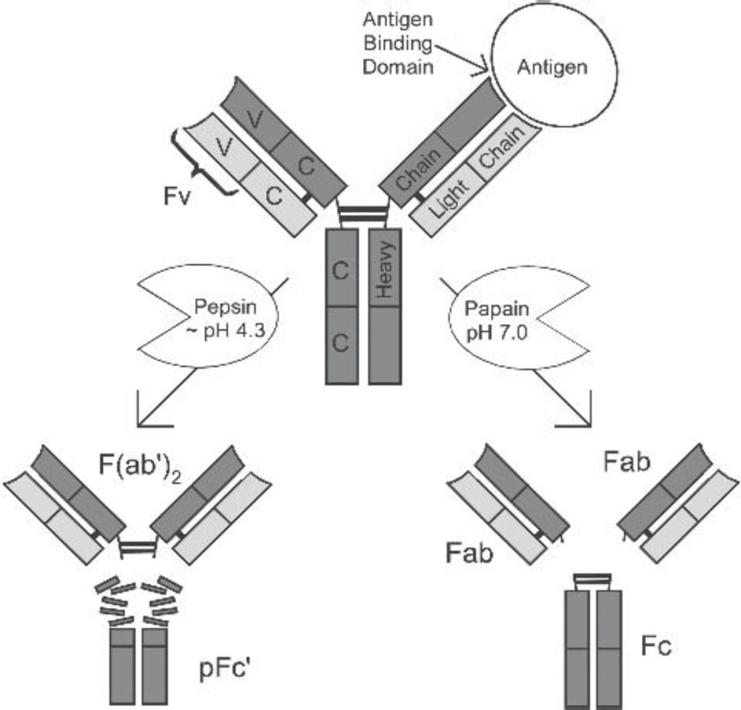
Figure1. The basic structural molecule of an antibody consists of a “Y”-shaped structure composed of two identical.
| ☎ +86-15801534258 | ✉ info@nebulabio.cn | Request a Quote ☜ |
☞Monoclonal Antibody Service Development Process
Our development process is a systematic, multi-stage journey designed for reliability and success.
Stage 1: Immunization & Immune Response Monitoring
Immunogen Preparation: Your antigen is formulated with an optimized adjuvant.
Host Immunization: Animals receive primary and multiple booster injections according to a customized schedule.
Serum Titer Analysis: Regular bleeds are tested by ELISA to monitor the development of a specific, high-titer antibody response before proceeding to fusion.
Stage 2: Hybridoma Generation & Primary Screening
Cell Fusion: Splenocytes from the immunized animal are fused with myeloma partner cells using polyethylene glycol (PEG) or electrofusion.
HAT Selection & Culturing: Fused cells are plated in HAT selection medium to eliminate unfused myeloma cells and allow only hybridomas to proliferate.
High-Throughput Primary Screening: Culture supernatants from hundreds of wells are screened (typically by ELISA) to identify those producing antigen-specific antibodies.
Stage 3: Subcloning & Cell Line Stabilization
Limiting Dilution: Positive primary wells are subcloned by limiting dilution at least twice to ensure clonality and stability, guaranteeing the antibody is produced by a single progenitor cell.
Cryopreservation: The stable, monoclonal hybridoma cell line is expanded, characterized, and cryopreserved in multiple vials for long-term security and future production.
Stage 4: Antibody Production & Purification
Small-Scale Production: Antibody is produced in vitro in tissue culture flasks or via mouse ascites method (where applicable and ethically approved).
Purification: The antibody is purified from the culture supernatant or ascitic fluid using affinity chromatography (Protein A/G for most IgG isotypes) or antigen-specific affinity columns.
Concentration & Buffer Exchange: The purified antibody is concentrated and dialyzed into a standard storage buffer (e.g., PBS) or a client-specified formulation.
☞Applications of Custom Monoclonal Antibodies
The high specificity and consistency of monoclonal antibodies make them indispensable across life sciences and medicine.
■ Therapeutic Development: As the direct drug substance (e.g., checkpoint inhibitors, anti-TNFα therapies) or as critical reagents for pharmacokinetic (PK), pharmacodynamic (PD), and immunogenicity (ADA) assays during drug development.
■ In Vitro Diagnostics (IVD): As the core capture and detection components in ELISA kits, lateral flow assays, chemiluminescent immunoassays (CLIA), and automated clinical analyzers for detecting disease biomarkers.
■ Fundamental & Translational Research:
Western Blotting: For specific protein detection in complex lysates.
Immunohistochemistry (IHC) & Immunofluorescence (IF): For visualizing protein localization and expression in tissue sections and cells.
Flow Cytometry: For phenotyping and sorting specific cell populations based on surface or intracellular markers.
Immunoprecipitation (IP) & Chromatin IP (ChIP): For isolating proteins or protein-DNA complexes from solution.
Functional Assays: For blocking or activating specific pathways in cellular assays.
☞Nebulabio Service Workflow
Our client-centric workflow ensures a collaborative, transparent, and efficient partnership from concept to delivery.
Step 1: Initial Inquiry & Project Scoping Contact us with your target information and application needs. We will schedule a technical consultation to discuss details and provide a formal project proposal with timeline and cost. | | Step 2: Project Kick-off & Antigen Submission Upon agreement, we send a project initiation package. You provide the antigen (>500 µg recommended). Our scientific team finalizes the detailed protocol. |
Step 3: Immunization & Immune Monitoring We begin the immunization program. You will receive serum titer reports at defined intervals, demonstrating the immune response progression. | Step 4: Hybridoma Generation & Screening Report After fusion, we provide a screening report identifying the number of antigen-positive hybridomas. We will discuss the results and the strategy for subcloning the most promising leads. | |
Step 5: Subcloning, Characterization & Client Review We perform limiting dilution cloning and produce small-scale antibody from the lead clones. Data on specificity (e.g., ELISA, preliminary Western) is sent to you for review and clone selection. | Step 6: Scale-Up, Purification & Final Delivery We scale up production of your selected clone(s), purify the antibody, and perform agreed-upon QC. The final deliverable includes the purified antibody, the cryopreserved hybridoma cell line, and a comprehensive Certificate of Analysis and project report. |
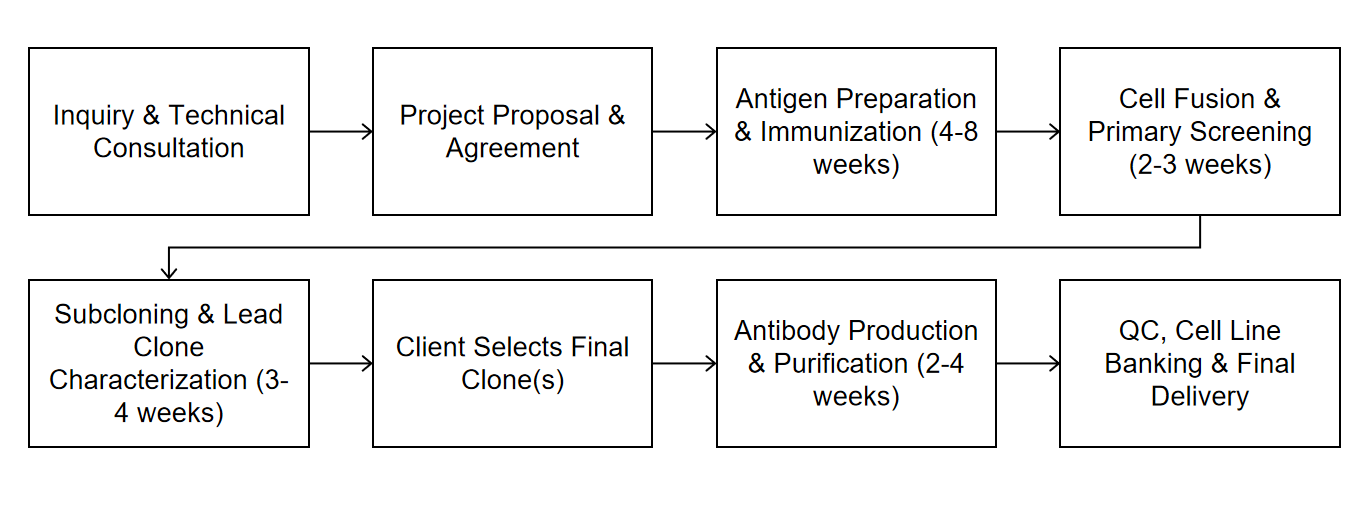
Nebulabio Service Process Flowchart:
Partner with Nebulabio to develop the precise monoclonal antibody tool you need. Our expertise and comprehensive service transform your antigen into a validated, high-performance reagent that drives your research or product development forward.
| For more information, please contact us at info@nebulabio.cn or +86-15801534258. |