


About Us
Nebulabio is a globally recognized leader in custom monoclonal antibody development, with over 20 years of specialized expertise in murine hybridoma technology. Our Mouse Monoclonal Antibody Development Service is built upon this legacy, offering researchers, diagnostic developers, and therapeutic companies a reliable, proven pathway to obtain highly specific, high-affinity antibodies against any antigen of interest. Our state-of-the-art facilities house dedicated teams of immunologists and cell biologists who manage the entire process—from strategic antigen design and ethical animal immunization to sophisticated screening, rigorous subcloning, and scalable production. We have successfully generated thousands of mouse monoclonal antibodies against a vast spectrum of targets, including challenging membrane proteins, phospho-specific epitopes, and small molecule haptens. Our commitment is to deliver not just an antibody, but a fully characterized, immortalized cell line and a consistent, high-performance reagent that forms the cornerstone of your research or product development.
☞Overview of Mouse Monoclonal Antibodies
A mouse monoclonal antibody is an immunoglobulin produced by a single, genetically identical clone of B cells, all derived from a single parent cell. It is a homogeneous population of antibody molecules that bind with high specificity to a single, unique epitope (antigenic determinant) on a target antigen.
This technology, pioneered by Köhler and Milstein in 1975, revolutionized biomedical science. The development process involves immunizing a mouse with an antigen of interest, fusing antibody-producing spleen cells from that mouse with immortal myeloma cells, and then isolating and cloning a single hybrid cell (a hybridoma). This hybridoma proliferates indefinitely in culture, secreting a single, defined antibody isotype (e.g., IgG1, IgG2a, IgG2b, IgG3, IgM).
The key advantages of mouse monoclonal antibodies include:
Unmatched Specificity: Binds to a single epitope, minimizing cross-reactivity and enabling precise target detection.
Unlimited Supply: The hybridoma cell line provides a permanent, consistent source of the identical antibody, ensuring batch-to-batch reproducibility.
High Purity & Homogeneity: Can be produced and purified to very high levels of purity from in vitro culture systems.
Versatile Engineering: The murine sequence serves as an excellent starting point for chimerization or humanization for therapeutic applications, and for conjugation to labels, enzymes, or toxins.
☞Mouse Monoclonal Antibody Development Process
Our standard mouse monoclonal antibody (mAb) development service follows a robust and time-tested five-stage hybridoma technology pipeline, as illustrated in the representative workflow. This systematic approach ensures the generation of high-specificity, clonally pure antibodies suitable for a wide range of applications.
Stage 1: Immunization
This initial phase is critical for eliciting a strong and specific immune response. We typically immunize mice or rats with the target antigen, which can be a purified protein, whole cells, or peptides conjugated to a carrier protein for enhanced immunogenicity. Immunizations are performed using optimized protocols with adjuvants such as Complete Freund's Adjuvant (CFA) for the primary immunization and Incomplete Freund's Adjuvant (IFA) for boosts. The immunization strategy—encompassing the primary injection, booster schedule, dose, administration site, and frequency—is carefully designed for each project. Antibody responses in the host animals are monitored through serial tail bleeds and titer analysis to determine the optimal time for cell fusion.
Stage 2: Fusion and Selection
Spleen cells harvested from the immunized animal, rich in antigen-specific B lymphocytes, are fused with immortal myeloma cell partners (such as Sp2/0, NS-1, or NSO) using a fusing agent like polyethylene glycol (PEG). This fusion creates hybridomas—hybrid cells that combine the antibody-producing capability of B cells with the immortal growth properties of myeloma cells. The fusion mixture is then plated in a HAT (hypoxanthine-aminopterin-thymidine) selective medium, which allows only the successful hybridomas to survive and proliferate. Viable hybridoma colonies are subsequently scanned and propagated in HT medium to ensure stable growth before screening.
Stage 3: Screening
In this high-throughput phase, culture supernatants from hundreds to thousands of hybridoma wells are primarily analyzed for the presence of desired antibodies. Screening is performed using methods specified by the client, such as Immunocytochemistry (IC), Enzyme-Linked Immunosorbent Assay (ELISA), Hemagglutination Assay (HA), or Western Blot (WB). Hybridomas that test positive are promptly expanded in tissue culture. These selected clones undergo a critical re-evaluation process to confirm reactivity and specificity. Finally, the most promising hybridomas are cryopreserved to secure the valuable cell lines for future use.
Stage 4: Characterization
Selected lead hybridoma clones undergo comprehensive characterization. This includes determining the antibody isotype (e.g., IgG1, IgG2a, IgM). To ensure monoclonality and stability, positive clones are subjected to cloning (typically by limiting dilution) and the resulting monoclonal lines are again cryopreserved. Antibodies are then purified from culture supernatant or ascites, and their specificity is rigorously verified. Further reactivity profiling and epitope mapping (as exemplified in the provided figure mapping MAb A57H against human IgG) may be conducted. The antibodies are validated against other relevant reagents to rule out cross-reactivity. Following successful characterization, the process can proceed to bulk production to generate milligram to gram quantities of the purified monoclonal antibody.
Stage 5: Further Developments
The developed monoclonal antibody serves as a key reagent for diverse downstream applications. These include various research applications, such as use as specific probes in assays or for structure-function analyses. The antibody can be prepared for commercial distribution as a single reagent or incorporated into diagnostic kits. Further modifications to the MAb, such as conjugation to fluorophores or enzymes, can be performed. Notably, mouse mAbs often serve as the foundational molecule for therapeutic applications, guiding humanization and engineering efforts en route to clinical trials.
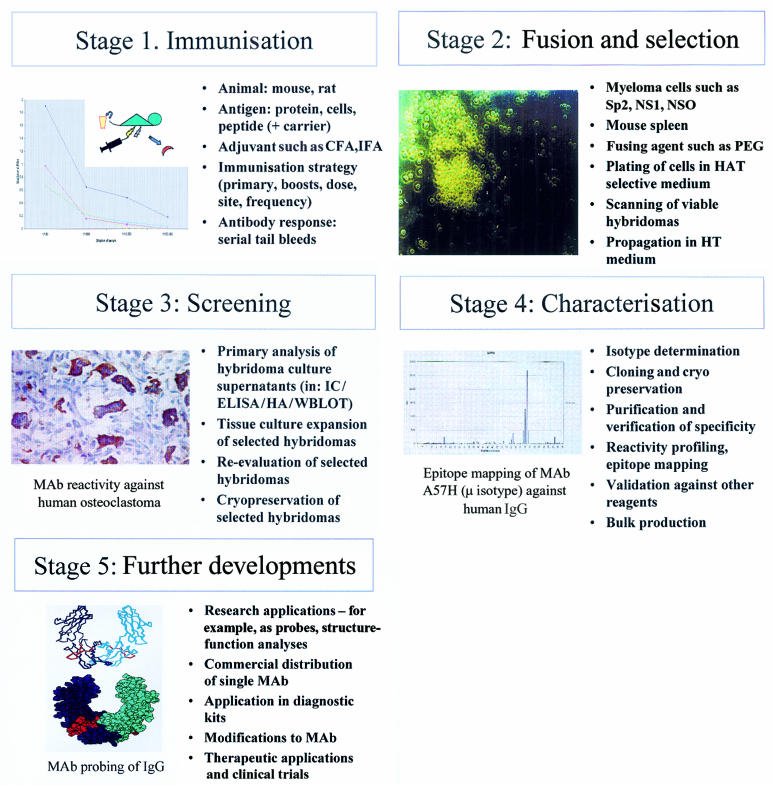
Figure1.Five stages of generating a murine monoclonal antibody (MAb).
| ☎ +86-15801534258 | ✉ info@nebulabio.cn | Request a Quote ☜ |
☞Types of Mouse Monoclonal Antibodies
Nebulabio develop antibodies tailored to diverse research and commercial needs. Our service can be directed to generate specific antibody types:
■ By Isotype & Application:
IgG1: Excellent for immunoassays (ELISA, Western blot), immunohistochemistry (IHC), and flow cytometry. Binds well to Protein A and G.
IgG2a & IgG2b: Often exhibit high affinity and are potent activators of complement-dependent cytotoxicity (CDC) and antibody-dependent cellular cytotoxicity (ADCC) in mouse model systems. Ideal for functional blocking/neutralization studies.
IgG3: Less common, but can be highly effective in complement activation.
IgM: Useful for agglutination assays and detecting repetitive epitopes due to its pentameric structure.
■ By Specificity & Target:
Phospho-Specific Antibodies: Developed using phosphorylated peptides as immunogens, enabling the study of cell signaling pathways.
Conformation-Specific Antibodies: Generated using natively folded proteins, ideal for detecting specific functional states of a target.
Anti-Hapten/Peptide Antibodies: Specialized service for small molecules, tags (HA, FLAG, Myc), or short peptide sequences.
Anti-Idiotypic Antibodies: Developed against a therapeutic antibody's unique variable region for pharmacokinetic (PK) and anti-drug antibody (ADA) assays.
☞Nebulabio Service Workflow
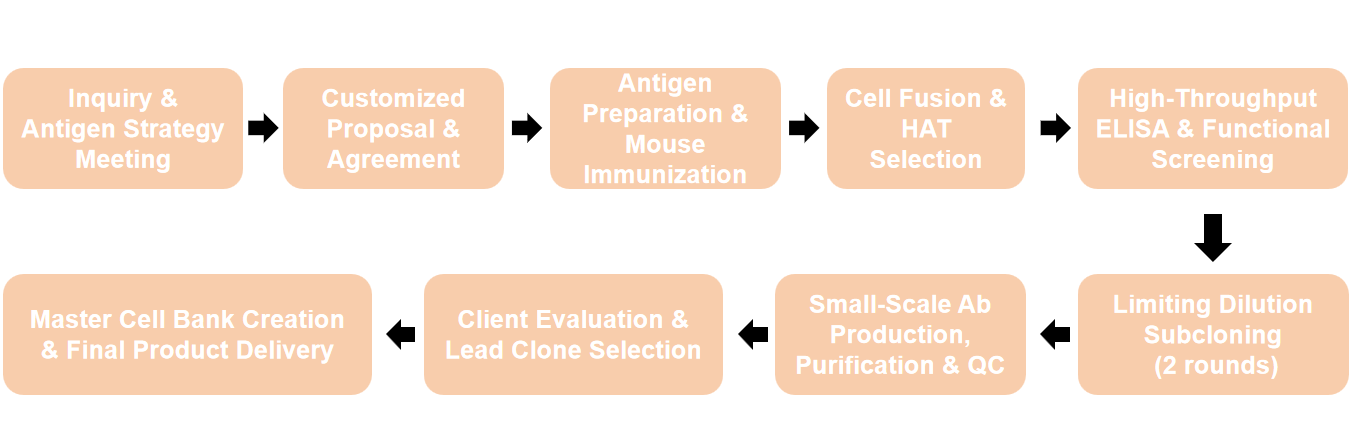
Our client-centric workflow ensures a transparent, collaborative, and efficient partnership.
Step 1: Project Consultation & Proposal Contact us with your antigen details and project goals. We will provide a detailed proposal outlining the strategy, timeline, and deliverables. | | Step 2: Project Initiation & Antigen Submission Upon agreement, we send a project kick-off package. You provide the purified antigen (>500 µg recommended). Our scientific team finalizes the protocol. |
Step 3: Immunization & Progress Reporting We begin the immunization program. You receive serum titer reports to monitor immune response development. | Step 4: Fusion, Screening & Clone Selection Report We perform cell fusion and high-throughput screening. You receive a comprehensive report detailing the number of positive hybridomas, their isotypes, and preliminary characterization data to assist in selecting leads for subcloning. | |
Step 5: Subcloning, Production & Client Evaluation We subclone the selected hybridomas to monoclonality. Small-scale antibody is produced, purified, and a sample is shipped to you for evaluation in your specific assays. | Step 6: Cell Line Banking & Final Delivery After your confirmation, we deliver the final product: the purified monoclonal antibody (mg quantities), the cryopreserved hybridoma Master Cell Bank, and a comprehensive Certificate of Analysis. |
Nebulabio Service Process Flowchart:
☞Applications of Mouse Monoclonal Antibodies
Mouse monoclonal antibodies are indispensable tools across the life sciences continuum:
1.Basic & Translational Research:
Protein Detection & Analysis: Western blotting, ELISA, flow cytometry (FACS)
Cellular & Tissue Imaging: Immunohistochemistry (IHC), immunofluorescence (IF), immunocytochemistry (ICC).
Protein Interaction & Functional Studies: Immunoprecipitation (IP), co-immunoprecipitation (Co-IP), chromatin IP (ChIP), blocking/neutralization assays.
2.In Vitro Diagnostics (IVD) Development:
Core Reagent in Assays: Used as matched pairs in sandwich ELISA, chemiluminescent immunoassays (CLIA), lateral flow tests, and automated clinical analyzers for detecting disease biomarkers (infectious disease, oncology, cardiac markers).
3.Therapeutic & Preclinical Development:
Therapeutic Candidate: Murine antibodies can be chimerized or humanized to become therapeutic agents.
Critical Reagents: Essential for pharmacokinetic (PK), pharmacodynamic (PD), and immunogenicity (ADA) assays during biotherapeutic drug development.
Target Validation & Biomarker Discovery: Used to interrogate protein function and expression in disease models.
Partner with Nebulabio’s experts for your mouse monoclonal antibody project. Leverage our proven technology and deep experience to obtain a precise, high-quality reagent that accelerates your research and development timelines.
| For more information, please contact us at info@nebulabio.cn or +86-15801534258. |