


How do stable gene knockdown cell lines achieve sustained and reproducible suppression of target gene expression? This article provides a research-focused overview of the core concepts behind stable knockdown cell lines, commonly used host systems (HEK293 and CHO), the logic of RNA interference and CRISPR interference, gene delivery and selection terminology (lentivirus, puromycin, hygromycin B, Geneticin (G418), blasticidin), and the roles of qPCR, Western blot, flow cytometry, and ELISA in defining knockdown efficiency and stability.
1. Core Concept of Stable Gene Knockdown Cell Lines
A stable gene knockdown cell line is an engineered mammalian cell system in which gene-suppressive elements are stably maintained, allowing a target gene to remain consistently downregulated across long-term culture and multiple passages. In contrast to transient knockdown approaches such as siRNA, stable knockdown models establish gene suppression as a steady-state property of the cell rather than a short-lived perturbation.
In research settings, the value of stable knockdown lies not in the speed of suppression but in its durability and reproducibility. When experimental objectives involve long-term phenotypes, pathway dependency, or cross-experiment comparison, transient knockdown approaches often introduce variability that complicates interpretation.
2. RNAi and CRISPRi as Complementary Knockdown Strategies
Stable gene knockdown is commonly achieved through RNA interference–based systems or CRISPR interference. RNAi approaches rely on sustained expression of shRNA or miR-shRNA to promote degradation of target mRNA, resulting in reduced protein expression. This strategy is broadly applicable and compatible with many mammalian cell backgrounds.
CRISPRi employs a catalytically inactive Cas9 (dCas9) fused to transcriptional repression domains such as KRAB to suppress gene expression at the transcriptional level. Because CRISPRi does not depend on mRNA degradation, it can be advantageous in cases where RNAi efficiency is variable or where transcriptional control is preferred. The two approaches are best viewed as complementary tools rather than interchangeable solutions.
3. Host Cell Context: HEK293 versus CHO
The host cell line strongly influences knockdown stability and interpretability. HEK293 cells are widely used due to their high compatibility with gene delivery and responsive regulatory architecture, making them suitable for mechanistic and signaling studies. CHO cells, by contrast, are valued for long-term culture stability and consistency, supporting experimental designs that require extended observation or repeated measurements.
Selecting an appropriate host is therefore a matter of aligning target biology and experimental objectives with the cellular context in which knockdown effects can be most reliably observed.
4. Gene Delivery and Selection Terminology
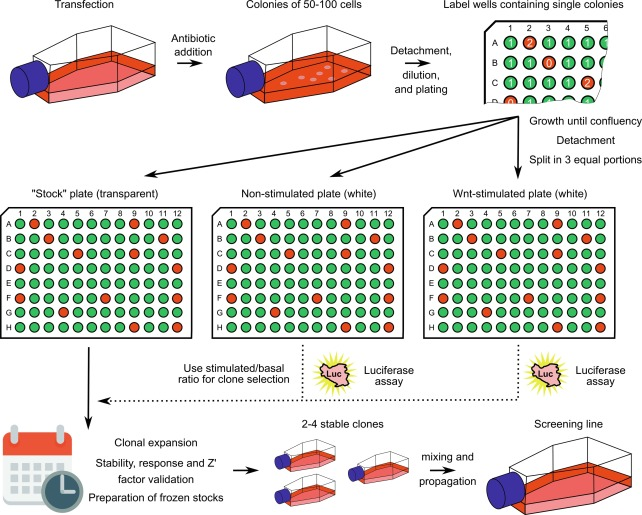
Establishing a stable knockdown cell line requires long-term retention of knockdown constructs within the host genome. Lentiviral systems are commonly used because they support efficient transduction and stable integration across diverse cell types.
Selection pressure is applied to enrich knockdown-positive populations, typically using antibiotics such as puromycin, Geneticin (G418), hygromycin B, or blasticidin. These agents differ in selection kinetics and compatibility with different cell types, and their use is guided by host tolerance and experimental design rather than maximal stringency.
5. Polyclonal Pools and Monoclonal Knockdown Lines
Stable knockdown cell lines are delivered either as polyclonal pools or as monoclonal lines. Polyclonal pools represent the aggregate effect of multiple independent integration events and are advantageous for rapid establishment and population-average analysis. Monoclonal lines, derived from a single cell, provide more uniform suppression and clearer experimental baselines, supporting long-term and high-stringency studies.
6. Orthogonal Validation of Knockdown Stability
Defining stable knockdown requires validation at multiple levels. qPCR is used to quantify mRNA reduction and assess consistency across passages. Western blot confirms protein-level suppression, while flow cytometry provides insight into population-level uniformity. For secreted targets or supernatant-based readouts, ELISA enables quantitative comparison under defined conditions. Together, these methods establish knockdown as a reproducible, steady-state property.
7. Conclusion
Stable gene knockdown cell lines provide a structured approach to long-term gene suppression in mammalian systems. RNAi and CRISPRi offer complementary mechanisms of action; HEK293 and CHO host backgrounds shape knockdown behavior; lentiviral delivery and antibiotic selection support stable population establishment; and polyclonal versus monoclonal formats address different experimental priorities. Through orthogonal validation using qPCR, Western blot, flow cytometry, and ELISA, stable knockdown models become well-defined experimental tools for functional and mechanistic studies.
| For more information, please contact us at info@nebulabio.cn or +86-15801534258. |