



Overview
Nebulabio offers a specialized service for the custom production of canine-derived monoclonal and polyclonal antibodies. This platform addresses the critical need for highly specific, species-matched immunological reagents in veterinary medicine, comparative oncology, and biomedical research involving canine models. As dogs share a significant physiological and pathological homology with humans, they serve as invaluable models for studying a wide range of diseases, including cancer, metabolic disorders, and infectious diseases. However, the lack of well-characterized, canine-specific antibodies has historically been a major bottleneck. Our service directly fills this gap by utilizing the canine immune system to generate antibodies against canine, human, or pathogen-specific antigens. We provide a complete solution, from antigen design and dog immunization to advanced hybridoma development for monoclonals, purification, and validation. Our goal is to empower veterinary drug development, advance translational research, and enable the creation of superior diagnostic and therapeutic tools for both canine and human health.
☞Introduction to Canine Derived Antibodies
Canine-derived antibodies are immunoglobulins generated by the immune system of dogs. Their unique value stems from their application in two primary, interconnected domains:
For Veterinary Medicine & Canine Health: The primary application is the creation of species-matched reagents. Using mouse or rabbit antibodies against canine targets often leads to high background or cross-reactivity issues in immunoassays due to anti-species secondary antibody interference. Canine-derived antibodies, when paired with anti-canine secondary antibodies, provide superior specificity and lower background in techniques like Immunohistochemistry (IHC) on dog tissue samples, flow cytometry for canine immunophenotyping, and ELISAs for measuring canine cytokines or biomarkers. This is essential for accurate veterinary diagnostics, pathogenesis studies, and the development of canine-specific biologics.
For Translational Human Health Research: Dogs are outstanding spontaneous disease models, particularly for complex conditions like lymphoma, osteosarcoma, melanoma, and autoimmune diseases. Generating antibodies against conserved canine-human targets (e.g., CD20, HER2, PD-1) within the canine system allows for:
Preclinical Therapeutic Testing: Evaluating antibody-based therapeutics (e.g., checkpoint inhibitors, antibody-drug conjugates) in a immunocompetent, large-animal model with naturally occurring disease, providing data highly predictive of human clinical outcomes.
Biomarker Discovery: Identifying and validating disease biomarkers using canine-specific antibodies, which can directly inform human biomarker studies.
The canine immune system is robust and can be leveraged using both polyclonal (from immunized dog serum) and monoclonal (via canine hybridoma or recombinant DNA technologies) approaches.
☞Canine Derived Antibody Production Process
Our process is tailored to the unique requirements of working with canine hosts, focusing on ethical standards, welfare, and scientific rigor.
A. Monoclonal Antibody Development (Canine Hybridoma Technology):
Immunization: Healthy, client-owned dogs (under strict ethical oversight and owner consent) or purpose-bred canines are immunized with the target antigen following a customized, welfare-focused protocol.
Lymphocyte Isolation: After a strong immune response is confirmed, peripheral blood mononuclear cells (PBMCs) or splenocytes are collected.
Fusion & Hybridoma Creation: Canine B lymphocytes are fused with a proprietary canine-murine heteromyeloma fusion partner cell line, optimized for stability and antibody secretion.
Screening & Cloning: The resulting hybridomas are screened for antigen-specific antibody production. Positive clones are isolated and subcloned to ensure monoclonality.
Characterization & Production: The monoclonal antibody is isotyped, and the hybridoma cell line is banked. Antibodies are produced in vitro and purified via affinity chromatography.
B. Polyclonal Antibody Production:
Ethical Immunization: Dogs are immunized with the antigen. The protocol is designed to maximize immune response while minimizing discomfort, often using modern adjuvant systems.
Phlebotomy & Apheresis: Antibody-rich serum is collected through regular phlebotomy or, for larger volumes, specialized apheresis procedures performed by veterinary specialists.
Serum Processing & Purification: Serum is processed to obtain whole antiserum or is further purified to isolate the IgG fraction.
| ☎ +86-15801534258 | ✉ info@nebulabio.cn | Request a Quote ☜ |
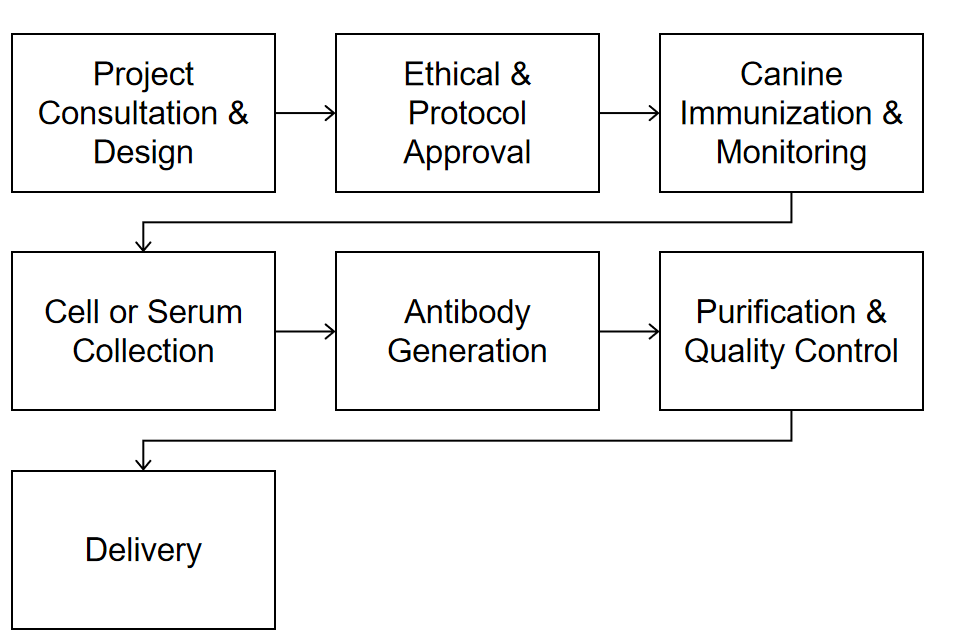
☞Nebulabio’s Service Process
Phase 1: Project Strategy
This initial, collaborative phase sets the scientific and ethical foundation. We begin with a detailed Consultation to define your target antigen, the desired antibody type (monoclonal for a single, defined reagent or polyclonal for a broad-epitope serum), scale, and intended application (e.g., IHC, flow cytometry, preclinical therapy). Following this, all procedures undergo Ethical & Protocol Approval. We work with veterinary partners and Institutional Animal Care and Use Committees (IACUCs) to finalize immunization and collection protocols that prioritize animal welfare, ensuring the project meets the highest ethical standards.
Phase 2: Immunization & Cell Preparation
In this execution phase, the canine immune response is elicited and monitored. Selected dogs undergo a customized Immunization Protocol using your antigen. We perform regular health checks and Titer Monitoring via ELISA to track the development of a robust antigen-specific antibody response. Once an optimal immune response is confirmed, the source material is collected. For monoclonal projects, Lymphocyte Collection is performed, where peripheral blood mononuclear cells (PBMCs) or splenocytes (depending on the protocol) are harvested under sterile conditions. For polyclonal projects, the process moves directly to serum collection.
Phase 3: Antibody Generation
This is the core technical phase where antibodies are created. The path diverges based on the project type:
Monoclonal Path: The collected lymphocytes undergo Hybridoma Fusion with a specialized fusion partner cell line. The resulting cells are cultured, and their supernatants are systematically Screened to identify wells producing the target antibody. Positive hits are then Subcloned through limiting dilution to ensure they are derived from a single progenitor cell, guaranteeing monoclonality and the production of a uniform antibody.
Polyclonal Path: Antibody-rich Serum is collected via phlebotomy. For larger volumes or higher purity, Apheresis may be employed to collect plasma directly. The serum or plasma is then processed (clotted, centrifuged, filtered) to yield raw antiserum.
Phase 4: Output & Delivery
The final phase focuses on producing the purified, validated reagent. For monoclonal antibodies, the stable hybridoma clone is used for Antibody Production in culture, followed by Purification via affinity chromatography (e.g., Protein A/G). For polyclonal projects, the antiserum may be provided as-is or undergo IgG Purification. All final products undergo rigorous Quality Control (QC), including concentration measurement, specificity analysis, and functionality testing. The project culminates in the Delivery of the final antibody (or hybridoma cell line), accompanied by a Comprehensive Data Package—including the Certificate of Analysis, detailed protocols, and all QC data—ensuring you have everything needed for your research or development work.
☞Advantages and Applications of Canine Derived Antibodies
Key Advantages:
Species-Specific Specificity: Eliminates cross-reactivity issues in canine assays, leading to cleaner data and more accurate diagnostic results.
Translational Relevance: Antibodies generated in dogs against shared targets are directly applicable for preclinical testing in canine clinical trials, offering a highly predictive pathway for human drug development.
Robust Immune Response: Dogs typically mount strong, high-titer immune responses to a wide array of antigens, including conserved mammalian proteins.
Ethically Sourced, Welfare-First: We partner with veterinary clinics and research institutions under the highest ethical standards, ensuring animal welfare is paramount.
Primary Applications:
Veterinary Diagnostics: Development of IHC antibodies for cancer diagnosis (e.g., canine lymphoma, mast cell tumors), infectious disease detection, and biomarker assays.
Comparative Oncology: Creation of therapeutic antibody candidates (e.g., anti-canine CD20, CD52) for treating canine cancers, which simultaneously serve as proof-of-concept for human therapies.
Immunology Research: Generation of reagents to study the canine immune system in infectious diseases (e.g., Leishmaniasis), allergies, and autoimmune disorders.
Biopharmaceutical Development: Production of canine-specific monoclonal antibodies for therapeutic use in pets, a rapidly growing field.
☞Bridge the Gap in Translational and Veterinary Science
Nebulabio’s Canine Derived Antibody Production Service provides the essential, species-specific tools needed to advance both veterinary medicine and human health research. Partner with us to develop high-quality antibodies that leverage the unique power of the canine model.
Contact us to discuss your target and explore how canine immunology can accelerate your project.
| For more information, please contact us at info@nebulabio.cn or +86-15801534258. |